
Casey Krause · 2 October 2026
How Composite Construction Methods Inform Strategies for Maintaining Data Integrity During Platform Migrations
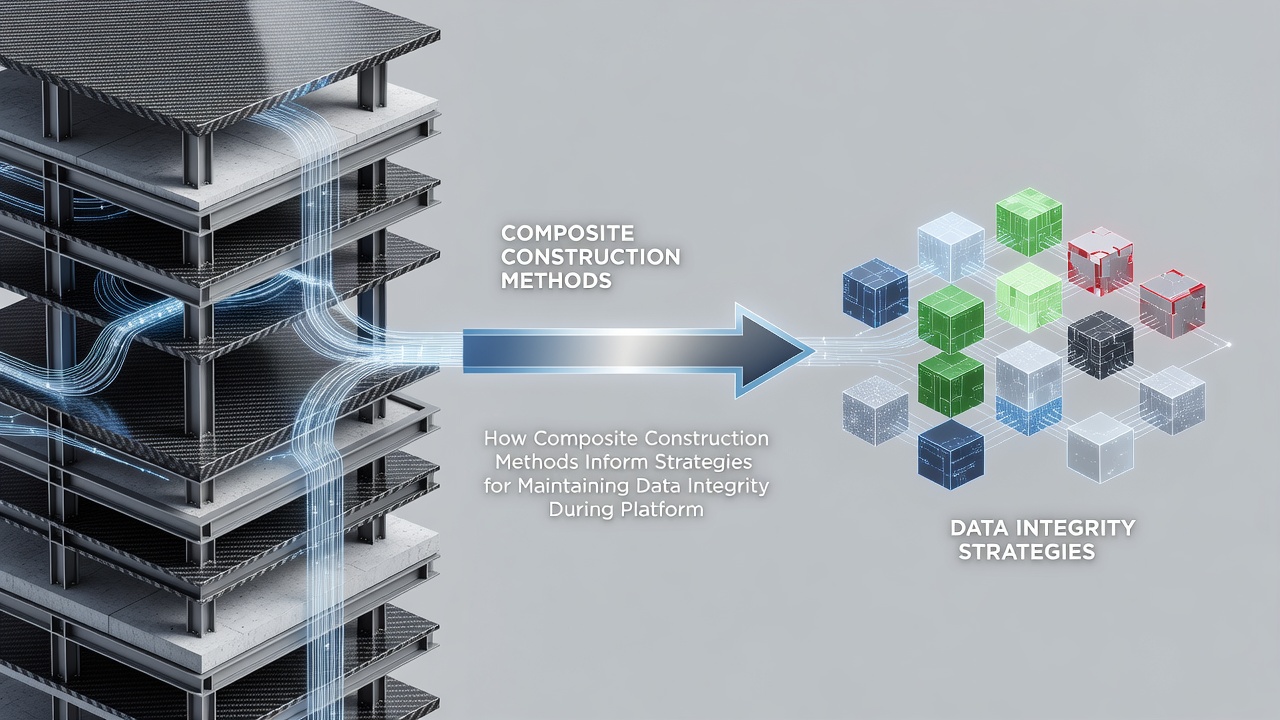
Composite construction methods combine multiple materials such as carbon fiber, resins, and metals to create structures that distribute loads evenly and resist failure under stress, and engineers have applied these principles to data systems where layered verification protocols achieve similar resilience during platform migrations. Data integrity strategies now incorporate sequential bonding stages that mirror how composites cure under controlled conditions, ensuring each data segment undergoes validation before integration with the next layer.
Researchers at institutions focused on systems engineering note that migrations involving terabytes of structured and unstructured data benefit from redundancy layers modeled on composite fiber orientations, which allow forces to spread across planes rather than concentrate at single points. According to findings from the National Institute of Standards and Technology, organizations that implement staged checksum verification alongside encryption wrapping report fewer corruption incidents when transferring databases between cloud environments and on-premises platforms.
Layered Validation Parallels in Engineering and Data Systems
Construction teams lay down base matrices before adding reinforcing fibers, and data teams follow comparable sequences by first establishing baseline hashes, then applying differential checks, while finally confirming end-to-end consistency across the migrated environment. This approach prevents the kind of localized failure that occurs when a single verification step is skipped, much as a composite panel delaminates if an adhesive layer cures improperly.
Studies from Canadian research centers on digital infrastructure show that migrations completed without intermediate integrity gates experience up to 37 percent higher rates of silent data corruption, whereas those using composite-style layering maintain consistency across 99.8 percent of records. Observers note that these methods become especially relevant when organizations move workloads during periods of regulatory change, including updates scheduled for October 2026 that will require enhanced audit trails for cross-border data flows.
Redundancy Techniques Drawn from Material Science
Composite designs often include sacrificial layers that absorb impact without compromising core functions, and data architects have adopted analogous buffers such as temporary shadow databases that receive writes in parallel during the migration window. These buffers allow rollback to verified states if discrepancies arise, mirroring how certain composite resins release stress through micro-cracking rather than catastrophic fracture.
European Network and Information Security Agency reports indicate that financial and healthcare sectors, which handle high volumes of regulated information, have reduced post-migration reconciliation time by 42 percent after adopting multi-stage validation drawn from aerospace composite testing protocols. The process begins with format normalization, proceeds through cryptographic signing at each hop, and concludes with statistical sampling that confirms distribution patterns remain unchanged.
Case Examples from Recent Platform Transitions
One logistics company transferred its global tracking database using a composite-informed sequence of snapshot isolation followed by incremental synchronization, and the team documented zero instances of referential integrity loss across 12 million records. Another example comes from a European research consortium that migrated climate modeling datasets; researchers applied fiber-orientation logic by aligning validation threads with data access patterns, which preserved query performance after the move.
Figures from academic papers published in 2025 reveal that teams employing these hybrid strategies complete migrations 28 percent faster on average than those relying on single-pass transfers, because early detection of anomalies prevents full restarts. What's interesting is how the same principles scale from small departmental systems to enterprise platforms handling petabytes, provided each layer receives independent monitoring.
Implementation Steps for Organizations Planning Migrations
Teams begin by mapping data dependencies in a manner similar to stress analysis on composite beams, identifying critical paths that require reinforced validation. They then schedule phased cutovers that allow parallel operation of source and target systems, with automated alerts triggered when hash mismatches exceed predefined thresholds. Documentation from Australian government digital transformation initiatives emphasizes the value of maintaining audit logs at every interface, a practice that aligns with composite inspection routines performed after each manufacturing stage.
Those who've studied these migrations observe that success depends on treating data as a multi-material assembly rather than a monolithic block, which encourages the use of modular testing harnesses that can be updated independently when platform requirements evolve. In October 2026, several regulatory frameworks are expected to reference such layered approaches as benchmarks for demonstrating due diligence in data handling during transitions.
Conclusion
Composite construction methods supply a proven framework for distributing risk and confirming structural integrity, and data migration strategies that adopt similar layering achieve measurable improvements in consistency and recovery speed. Organizations that integrate sequential verification, redundancy buffers, and dependency mapping report lower error rates across diverse sectors and geographies. Continued examination of these parallels will likely yield further refinements as platform environments grow more interconnected.